Choosing an electric cargo bike for business is not simply a matter of comparing battery sizes. It is an operational decision involving payload, route length, charging access, weather, rider safety, and service support. The wrong model may look efficient in a showroom but struggle on a steep delivery route with 120 kilograms of goods. That mistake becomes expensive quickly.
Industry evidence supports careful evaluation. A University of Westminster study found that cargo bikes completed central London deliveries faster than vans, with an average time advantage of about 60%. The finding is useful, but it does not apply equally to every business. A bakery carrying fragile products needs different equipment from a florist, pharmacy, or maintenance team. The European Commission’s Sustainable and Smart Mobility Strategy also identifies zero-emission urban logistics as an important transport priority. Meanwhile, the ITF Transport Outlook 2023 highlights increasing pressure on cities to reduce congestion, emissions, and delivery impacts. These reports show the direction of the market, not a guaranteed return on investment.
A practical buying process starts with real delivery data. Record daily distance, average load, maximum load, hills, parking conditions, and waiting time. Then compare motor torque, battery capacity, cargo-box dimensions, braking systems, weather protection, and warranty coverage. Test the bike with actual containers, not empty showroom boxes. Small details matter. A low step-through frame may reduce rider fatigue. A removable battery may solve an awkward charging problem. Still, no spreadsheet can predict every pothole, rushed turn, or rainy afternoon. The best choice combines published specifications with a realistic pilot period, honest rider feedback, and a clear maintenance plan.
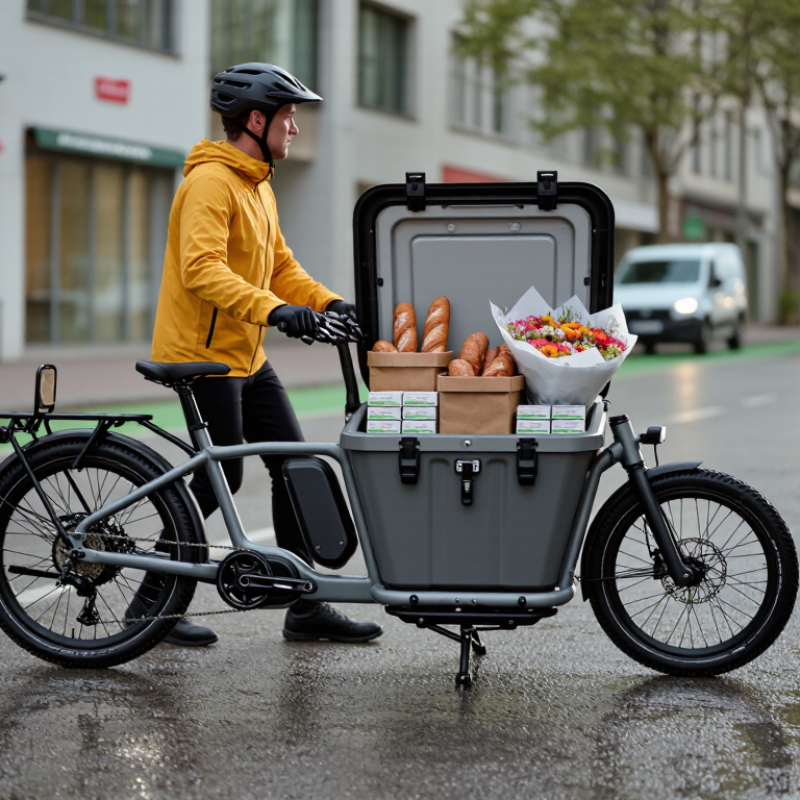
Choosing an electric cargo bike starts with the delivery route, not the battery display.
Measure daily distance, road surfaces, parking gaps, and the heaviest regular load. A bakery may need insulated space, while a repair service needs tool access and secure compartments. Record peak-hour stops for one week. This simple log often exposes unrealistic assumptions.
Match the frame and cargo box to actual weight, volume, and loading frequency.
A low loading height saves time when parcels move repeatedly. Stable handling matters on wet corners and crowded streets. Choose hydraulic disc brakes, visible lights, reliable locks, and weather-resistant cargo protection. Ask for a rated payload, not a generous-looking storage box.
The rider must fit too.
Check saddle adjustment, handlebar reach, step-over height, and standing comfort during frequent starts. Test it loaded. Not empty.
Battery capacity should reflect hills, cold weather, payload, and stop-and-go riding.
Plan charging where staff actually work, with safe electrical access and clear responsibility. Consider service intervals, replacement parts, warranty terms, and downtime procedures before purchase. A cheaper bike can become expensive when one disabled unit delays deliveries. I would leave a small capacity margin, though extra battery adds weight and cost. That balance is not perfect. Pilot one route for two weeks, then compare delivery time, rider fatigue, energy use, and missed stops. Real data may challenge the original specification, and that is useful.
When choosing an electric cargo bike for business, compare its working capacity, not just its advertised size. Check the maximum payload, cargo-bed dimensions, and weight distribution. A delivery box filled with groceries behaves differently from stacked tools. Ask whether the frame stays stable during tight turns and sudden stops. Low step-over height can help riders load quickly and safely.
Motor torque matters on hills and when starting with a full load. Compare battery capacity, charging time, and the estimated range under realistic weight. A range claim made with a light rider may not match daily operations. Removable batteries are useful when no charging point exists near the vehicle. However, a larger battery adds weight and may reduce handling comfort. More power is not always better.
Hydraulic or well-adjusted mechanical brakes deserve careful attention. Look for bright lights, reflective areas, strong stands, weather-resistant wiring, and puncture-resistant tires. Check whether common replacement parts are easy to obtain and whether service support is available locally. A simple display is often more reliable than an overly complex one. Test the bike with the actual cargo box, route, and rider if possible. A short showroom ride can feel excellent, yet it may hide fatigue after four hours. We sometimes underestimate rider comfort. Adjustable handlebars, a supportive saddle, and easy access to controls can affect productivity more than expected.
Compare usable battery capacity with your planned daily riding distance. This planning estimate assumes energy use of 25 Wh per mile and a 20% reserve; actual consumption varies with load, terrain, weather, and riding style.
What else to compare: rated payload (including rider and cargo), real-world range under load, charging time and battery removability, braking performance, cargo-box or rack dimensions, and local service availability. Check each bike’s rated limits and test it on a representative route before buying.
For a business, battery range should match a full working shift, not a showroom estimate. The European Cyclists’ Federation’s Cyclelogistics study estimated that 51% of motorized trips carrying goods in European cities could potentially shift to cargo bikes. That is potential, not a promise for every route. Map your actual stops, hills, load, and return journey before choosing a battery. A 25-kilometre delivery loop with frequent starts may use more power than steady riding on flat streets. Keep a reserve for delays and colder days. Small reserve.
Payload capacity matters just as much. Check the permitted cargo load and the bike’s total weight limit, including rider, locks, boxes, and tools. Then test the heaviest typical delivery, not an unusually light one. Heavy loads can affect braking, handling, and range. A spreadsheet can miss that. Consider whether bulky parcels fit securely, even when their weight is modest.
Plan charging around the workday. Record how long a depleted battery takes to recharge, and whether the bike can be plugged in safely between shifts. For multi-stop operations, ask whether a removable battery or a spare fits your routine. Charging access can become a bottleneck when several bikes return together. Track real-world energy use for a week before setting dispatch limits; early estimates are often too optimistic.
How to Choose an Electric Cargo Bike for Your Business? — Battery Range, Payload Capacity, and Charging Considerations
| Business Use | Typical Battery Capacity | Planning Range per Charge | Typical Cargo Payload Rating | Approx. 0–100% Charge Time* | What to Check Before Buying |
|---|---|---|---|---|---|
| Light local deliveries Documents, small parcels | 400–500 Wh | 30–60 km (19–37 mi) | 40–80 kg (88–176 lb) | About 5–8 hours with a 2 A charger | Confirm that the usable range covers the full route, including return travel and detours. Check that the cargo area securely holds the largest parcel. |
| Daily urban courier routes Mixed parcels and frequent stops | 500–750 Wh | 25–55 km (16–34 mi) | 60–100 kg (132–220 lb) | About 7–12 hours with a 2 A charger; faster with a compatible higher-current charger | Frequent starts, hills, cold weather, and heavy loads can shorten range. Match battery capacity to the busiest route, not just the average day. |
| High-volume or heavier deliveries Food, tools, or bulky goods | 750–1,000 Wh, or a compatible dual-battery setup | 20–45 km (12–28 mi) | 80–150 kg (176–331 lb) | About 10–16 hours with a 2 A charger; charging time depends on battery and charger specifications | Check the rated cargo payload, maximum gross vehicle weight, frame limits, and braking performance. A large battery does not increase the bike’s permitted payload. |
| Compact, short-distance business trips Retail errands or campus service | 300–500 Wh | 25–50 km (16–31 mi) | 30–70 kg (66–154 lb) | About 4–8 hours with a 2 A charger | Prioritize maneuverability and secure storage. Confirm that the battery can be removed and charged safely at the workplace if outdoor charging is unavailable. |
| Long operating day with an interim recharge | 500–750 Wh per battery; consider a spare only if approved for the bike | Plan around route length and recharge access; a mid-shift top-up can extend daily use | Use the bike’s stated rating; do not exceed it when carrying a spare battery or accessories | A 30–60 minute top-up adds charge, but the amount varies by charger, battery state, and temperature | Verify battery compatibility, workplace electrical access, charging-area safety, and whether staff can swap or secure batteries during a shift. |
Planning notes: Figures are typical estimates for electric cargo bikes, not specifications for a particular model. Actual range depends on rider and cargo weight, terrain, assist level, tire pressure, stops, temperature, and battery condition. Range estimates assume moderate pedal assistance and mostly urban riding. Payload ratings vary by design; check the manufacturer’s cargo limit and gross vehicle weight limit separately. Charging times are approximate and vary with battery voltage, charger output, and charging conditions.
How to Choose an Electric Cargo Bike for Your Business?
A commercial cargo bike is only useful if staff can ride it safely through a full shift. Check the loaded bike’s braking distance, stable handling, lights, and visibility before choosing a model. Test it loaded. Add the real cargo weight, not just an empty crate. A low step-through frame, adjustable saddle, and reachable controls can reduce strain during frequent stops. The European Cyclists’ Federation’s Cyclelogistics Ahead study estimated that cargo bikes could handle about 25% of urban commercial deliveries. Treat that as a broad estimate: route layout and parcel size change the calculation.
Comfort affects safety, too. Ask riders to test the bike on actual streets, including tight turns, curb ramps, and rough pavement. Check that the load stays secure and does not block lights or the rider’s view. For electric-system safety, review applicable standards, such as UL 2849 or EN 15194, and verify what local rules require. These standards do not replace local vehicle classification, road-use, helmet, or insurance requirements.
Legal details vary by location. Confirm permitted motor power and assisted speed, equipment rules, and whether commercial use changes insurance or registration obligations. Keep a record of inspections and repairs; worn brake pads are easy to overlook in a busy delivery week. I would not choose on range alone. Battery estimates can disappoint in cold weather, with heavy loads, or on hilly routes. A practical trial may reveal what the specification sheet misses.
An electric cargo bike should be costed as a working asset, not automatically treated as a cheaper van.
Include the bike, cargo box, locks, spare battery, insurance, charging, and scheduled servicing. Keep a repair reserve. One broken wheel can erase a week’s delivery savings. The European Cyclists’ Federation’s 2014 Cyclelogistics study estimated that cargo bikes could replace 51% of motorized urban trips. That is potential, not a promise for every route: hills, distance, and bulky loads change the calculation.
Compare total cost per completed stop, including rider time and downtime.
The International Energy Agency reported that average lithium-ion battery pack prices fell 14% in 2023, to $139 per kilowatt-hour. That figure covers battery packs generally; it is not a quote for an e-bike replacement battery.
Ask suppliers for battery and service prices, then estimate replacement timing using your daily mileage and charging routine. Track repairs and missed deliveries for a few months. I would still test the bike on a real route before committing; a neat spreadsheet can miss a rough curb or a tight loading bay.
Reignite your passion for driving with Yokohama tires and experience the superior performance you deserve.